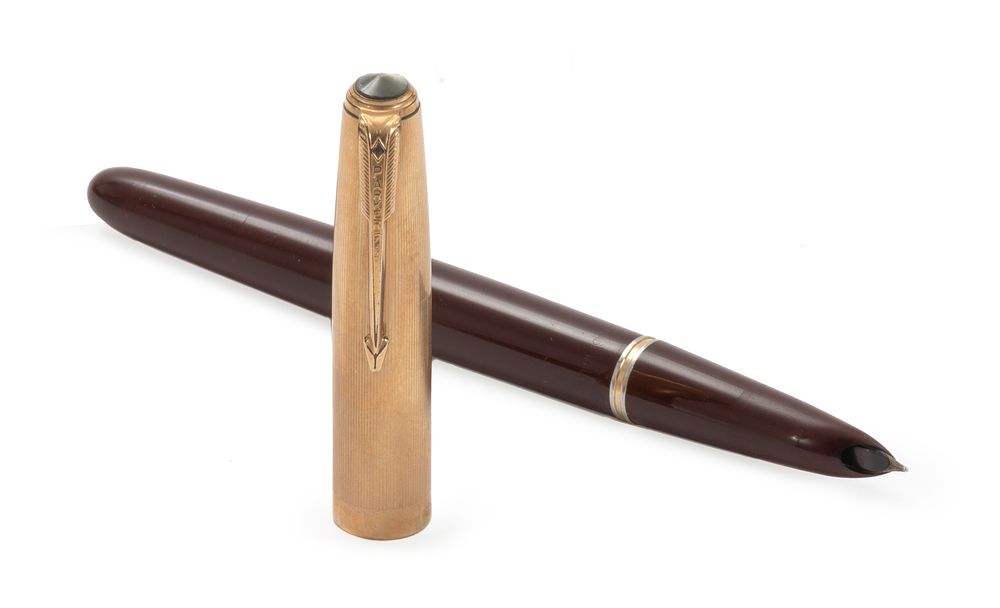
Fountain Pen Used to Sign Israel's Declaration of Independence – From the Estate of Minister David-Zvi Pinkas - Fountain pen of David-Zvi Pinkas, leading member of the Mizrachi movement, member of Moetzet HaAm and Government minister, used by him to sign the Declaration of Independence. Manufactured by Parker, USA, 1940s. Parker 51 fountain pen used by David-Zvi Pinkas to sign the parchment sheet appended to the Declaration of Independence, and apparently passed on by him to other signatories. Immediately after the ceremony, Pinkas wrote on a paper envelope, enclosed with the present pen: ”With this pen I signed, in a good and auspicious hour, the founding scroll of the State of Israel on Friday, 5 Iyar 1948, in the Museum Hall – Dizengoff House – Tel Aviv”, and placed the pen in the envelope. The Text of the Declaration of Independence and the Signing Ceremony The final text of the Declaration of Independence of the State of Israel was preceded by several drafts, disputes and lengthy discussions. The text ultimately selected, and approved at a meeting of Moetzet HaAm (the supreme body of the Yishuv, established in preparation for the declaration of the state and comprising representatives of all Yishuv parties; later becoming Moetzet HaMedinah HaZmanit – Provisional State Council), was based on a draft by Moshe Sharett (Chertok), and edited by David Ben-Gurion. Twenty-five members of the council attended the meeting at which the text was approved, held on Friday afternoon, 14 May 1948. The remaining eleven members were then in besieged Jerusalem, while one additional member was in the United States. On the afternoon of that Friday, Moetzet HaAm assembled in the museum hall on Rothschild Boulevard in Tel Aviv for the Declaration of Independence ceremony and the signing of the scroll. For various reasons, the declaration was prepared in haste, and the sofer stam did not have time to inscribe the final version of the text on the parchment scroll before the ceremony. Accordingly, Ben-Gurion read the text of the declaration from a typewritten sheet, and then became the first to sign his name on a blank parchment sheet; the other members of Moetzet HaAm then present in Tel Aviv were called, in alphabetical order, to sign their names on the sheet, the last signatory being Moshe Sharett. After the ceremony, this parchment sheet was deposited in the safe of the Anglo-Palestine Bank, and was later removed in order to add the signatures of the members of Moetzet HaAm who had been absent from the declaration ceremony. Subsequently, members of Minhelet HaAm approached a sofer stam from the Tel Aviv Rabbinate, asking him to copy the text of the Declaration of Independence onto parchment, in traditional stam script. His work, however, was unsuccessful, and the task of writing the scroll was assigned to Otte Wallish. Together with the graphic artist Rudi Sidner, Wallish completed the writing of the scroll, the sewing of the sheets, and the preparation of the state seal and cord by the end of July 1948. The scroll was then transferred to the Israel State Archives. The driving force behind the organization of the declaration ceremony, under Ze 'ev Sherf, was Dr. Avraham Dov Rivkind, of Keren Hayesod. In an article published in his memory by his brother, Yitzchak Rivkind, in the newspaper HaDoar (”On the History of the Declaration Ceremony and the Declaration of Independence Scroll”. New York, 26 April 1963 [Hebrew]), the course of events at the moment of signing is described in detail. According to the article, Rivkind insisted that each of the signatories sign while seated, and for this purpose was compelled to ask Haim-Moshe Shapira to vacate his chair. Rivkind further writes: ”When the members of Minhelet HaAm and Moetzet HaAm came up to sign, each took a fountain pen out of his pocket in order to sign. My brother stopped them and insisted that they all sign the founding scroll of the State of Israel with one pen”. Nevertheless, it appears that different members signed with different pens. The present pen is the only known pen surviving from the signing ceremony. David-Zvi Pinkas (1895-1952), one of the leaders of the Mizrachi movement, member of the Knesset and minister in the first governments of Israel. Born in Sopron (German: Ödenburg), Hungary, and raised in Vienna. He studied at the Pressburg Yeshiva and at the Faculty of Law of the University of Vienna. In his youth, he was one of the leaders of Tzeirei Mizrachi and among the founders of the Yeshurun movement, and participated as a delegate in Zionist Congresses. In 1925, he immigrated to Palestine and settled in Tel Aviv, where he managed Bank Mizrachi and headed several public and religious institutions. Pinkas was a member of the Assembly of Representatives, HaVa'ad HaLeumi and Moetzet HaAm, and was among the signatories of the Declaration of Independence. After the establishment of the state of Israel,