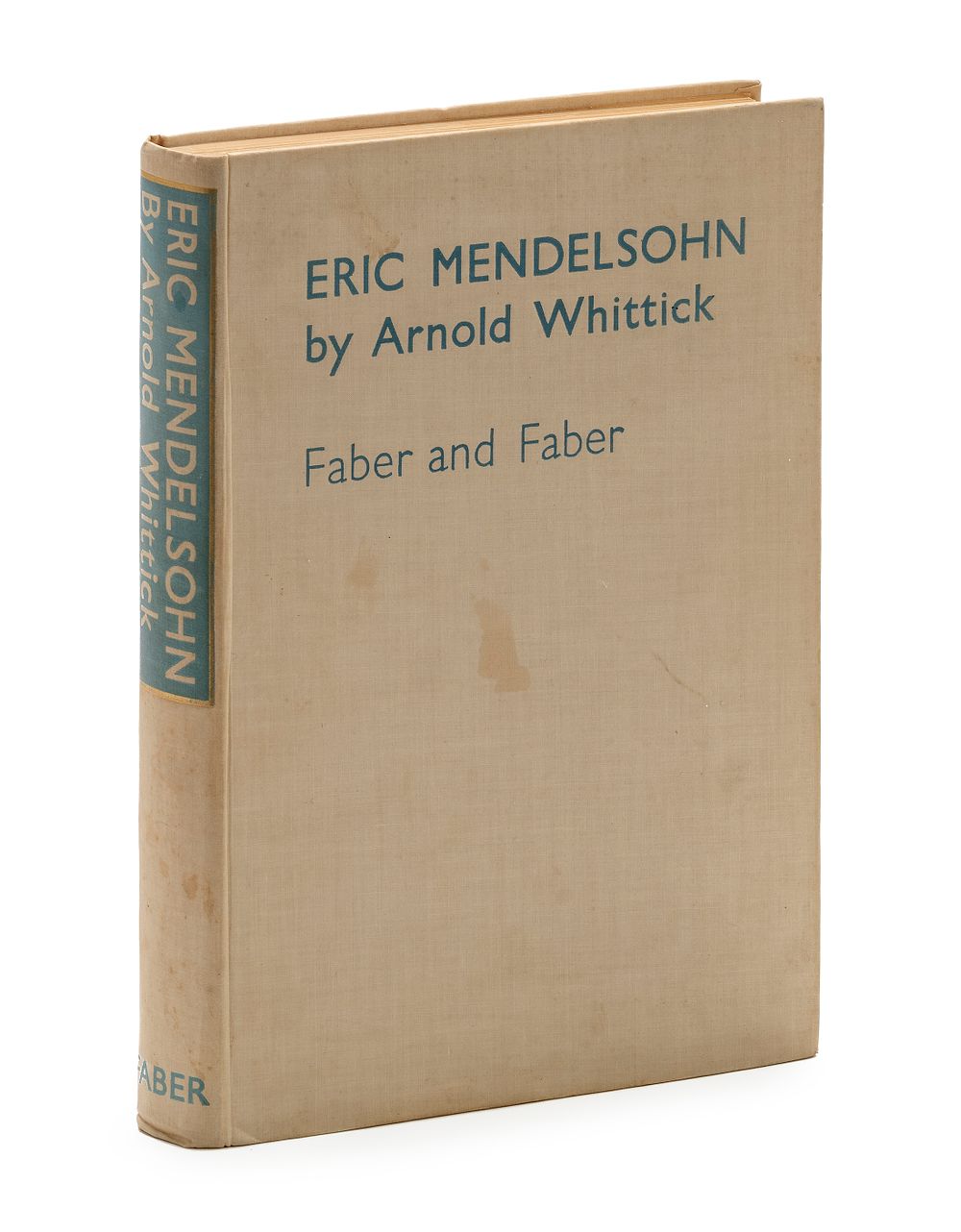
Monograph on Architect Eric Mendelsohn – London, 1940 – Mendelsohn's Personal Copy, with His Signature and Handwritten Dedication – ”I Learnt What I Dreamt Of” - Eric Mendelsohn, by Arnold Whittick. London: Faber & Faber, April 1940. First edition. English. Comprehensive monograph on the noted architect Eric Mendelsohn, authored by the scholar Arnold Whittick (in cooperation with Mendelsohn himself from late 1937). This book surveys Mendelsohn's beginnings in Europe and the development of his architectural style, and includes a dedicated chapter on his work in Palestine in 1934-1938. The book is accompanied by 26 plates (most printed on both sides of the leaf), including 54 photographs of structures and models, and reproductions of notes documenting Mendelsohn's work over the years. They depict his monumental projects in Europe (as the Einstein Tower in Potsdam, the Schocken department stores and Columbus House in Berlin), his prominent works in Palestine (including Chaim Weizman's private residence in Rehovot, Salman Schocken's home and library in Jerusalem, the Hebrew University campus, the Hadassah hospital on Mount Scopus, the Rambam hospital in Haifa and the trade school at Yagur), as well as portrait photographs of Mendelsohn (frontispiece) and his wife Luise (towards the end of the volume). The text incorporates 103 sketches, blueprints, diagrams and architectural notes. The present book was the personal copy of Eric Mendelsohn, featuring his signature, inscriptions and dedications in his handwriting (in red pencil). The front endpaper features his ownership inscription dated to the month of the book's printing, April 1940 (”Eric Mendelsohn IV/40”). Beneath this, he added in his handwriting: ”I learnt what I dreamt of”. Furthermore, the margins of many leaves feature emphasis and notations, in the same red pencil, made by Mendelsohn himself, who read the monograph about him and highlighted the paragraphs that drew his attention. About a year later, in March 1941, when his Jerusalem office was closed and soon before immigrating to the United States, Mendelsohn gave his personal copy as a parting gift to his friend Dr. Max Kreutzberger, adding a handwritten dedication in the endpaper. Eric Mendelsohn (1887-1953), a Jewish-German architect, was a pioneer of modern architectural expressionism and the representative of the times – the industrialization, the machine, the steel, the concrete and the glass. His journey began in Germany, where he was widely recognized for some of his iconic structures, including the Einstein Tower in Potsdam and the Schocken department store network of his friend and patron Salman Schocken. When the Nazis rose to power, he was compelled to leave Germany, and in 1934 he immigrated to Eretz Israel, opening his office in Jerusalem at the Rehavia windmill (currently the location of the Kedem Auction House). There he developed an architectural idiom, synthesizing modern functionality with Middle Eastern construction traditions, planning several local landmarks, including the Schocken library in Jerusalem, the Hadassah hospital on Mount Scopus and the Rambam hospital in Haifa. In 1941, when the war front of World War II drew nearer and construction in Eretz Israel slowed to a halt, he immigrated to the Untied States, settling in San Francisco. He lectured in the University of Berkely until his death, planning a series of prominent synagogues and community centers, such as the B'nai Amoona synagogue in St. Louis and the Park synagogue in Cleveland. Dr. Max Kreutzberger (1900-1978) was a historian, social worker and social activist, then the General Secretary of the German Immigrants' Association in Eretz Israel. His personal and professional acquaintance with Mendelsohn was partly due to the founding of the trade school in Yagur; Kreutzberger served as a trustee of the institution, while Mendelsohn was chosen as the architect to planned the building. The two were moreover pillars of the German immigrant community in Eretz Israel, and Kreutzberger often highlighted his contributions to the development of construction in Eretz Israel in the Association's newsletter. Kreutzberger later also immigrated ot the United States, serving as president of the Leo Baeck Institute in New York. 180 pages + [26] plates. 28 cm. Good condition. Minor defects. Original binding, with light stains and wear. Does not include original paper wrapper.