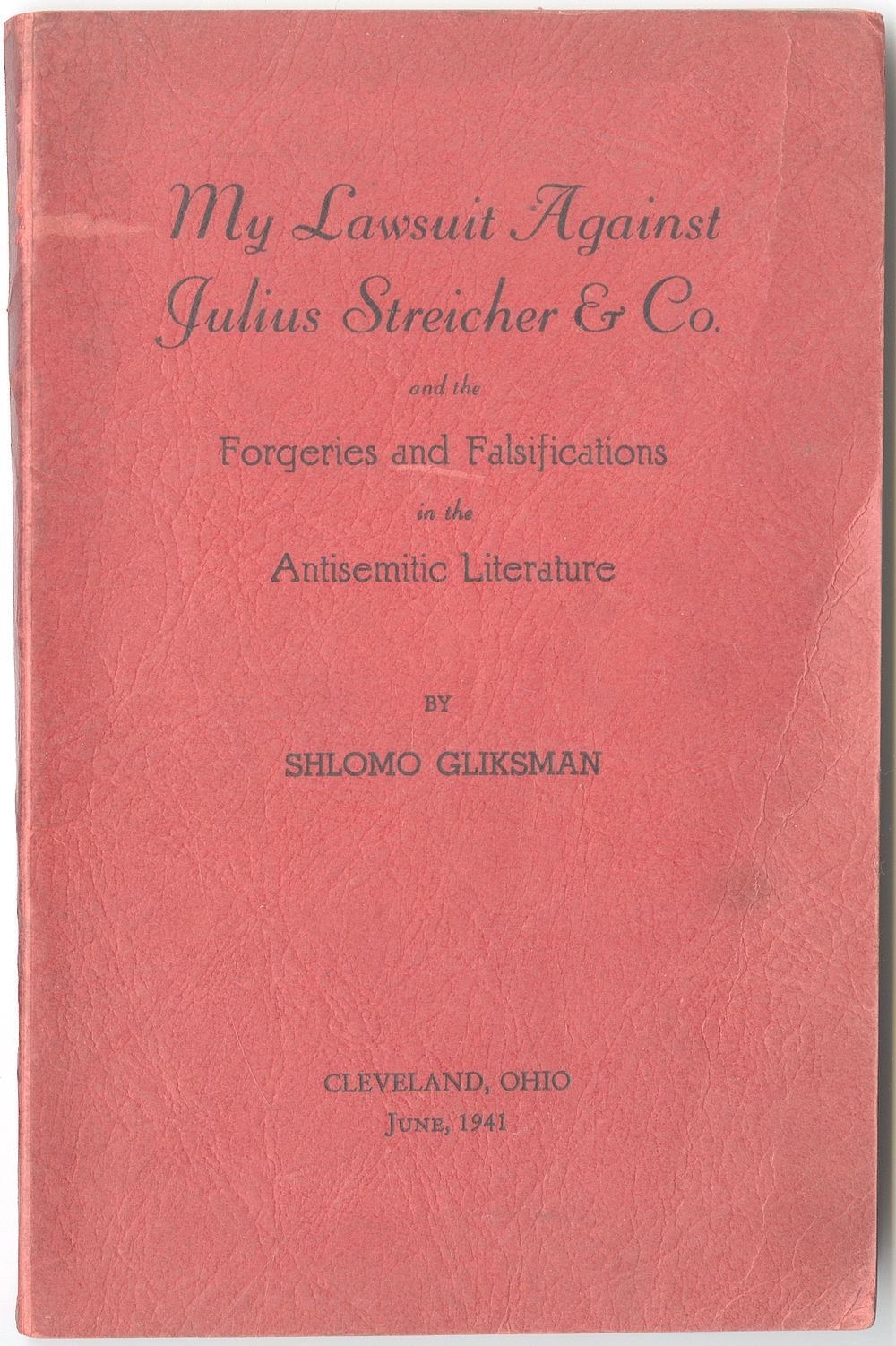
Solomon Gliksman - My Lawsuit Against Julius Streicher & Co. and the Forgeries and Falsifications in Antisemitic Literature - First English Edition - My Lawsuit Against Julius Streicher & Co. and the Forgeries and Falsifications in the Antisemitic Literature, by Rabbi and scholar Shlomo Gliksman. Published by the author, Cleveland, Ohio, June 1941 - First English edition, with additions that did not appear in the German edition - the book whose distribution in Germany was prohibited by personal order of Propaganda Minister Joseph Goebbels. ”Antisemitism is not an ideological concept, but in fact a chronic disease that pits the strong against the weak and helpless, even if the victim is an infant...”. Shlomo Gliksman (who signed some documents in German as Sami Glucksmann) formerly served as director of the Seminar for Jewish History, Bible, and Talmud in Danzig and as an official adviser on law and economics. In his book, he presents criminal complaints and legal actions that he filed in January 1935 with the Attorney General and the Police Commissioner in Danzig against the Nazi criminal and antisemitic propagandist of the regime Julius Streicher (editor of the notorious Der Stürmer) and his associate editors, explicitly demanding that the distribution of Der Stürmer in Danzig be prohibited and that local agents be investigated, basing his case on provisions of the criminal code and decisions of the Imperial Court protecting religious sentiments. In the complaint he filed, he quoted passages from Der Stürmer in which the newspaper disparaged the Bible, falsified Talmudic sources, denigrated the Jewish religion, and turned the Jews as a whole into an ostracized group - all in violation of the German Penal Code then in force in Danzig. He chose to publish his book, in which he recounts his struggle against German antisemitism and Streicher in particular, for the first time specifically in Danzig - the city in which he had initiated legal proceedings against Julius Streicher and his associates - because, under Article 102 of the Treaty of Versailles, it had remained a Free City, independent of the German Reich, and he believed that it was precisely there that he would receive support in his open struggle against Streicher. Indeed, the League of Nations did not prohibit the distribution of the book, and according to the introduction, thousands of copies were purchased even by members of the Nazi Party themselves. Despite the truthful claims he presented before the court, as reproduced here in his book, his lawsuit was rejected because the legal adviser to the Danzig government advanced the absurd argument that the author himself had not been personally harmed by the actions of Der Stürmer, thereby effectively dismissing all his claims at once. Naturally, following the publication of the book, he was persecuted by the Nazi Party, and when Gliksman learned that he had been placed on the Gestapo blacklist, he fled to the United States, where he promptly published the English edition of the book after the outbreak of World War II, at a time when many of the events that had occurred fully vindicated all the claims he had made in the book. In addition to the lawsuit he filed, which is reproduced here, the book is devoted to a scholarly and textual dismantling of antisemitic claims originating in the school of thought of Eisenmenger. He refutes the claims of antisemites ostensibly based on Jewish sources and demonstrates how propagandists distorted the sources of Judaism, quoting each of those Talmudic statements in full and demonstrating how Der Stürmer deletes entire lines that do not accord with the antisemitic claims it presents to its readers, and mistranslates Talmudic terms in order to adapt them to the antisemitic narrative. In his book, he also quotes the views of prominent figures in Germany who condemned antisemitism - among them individuals who had served as members of the German Reichstag, such as Theodor Mommsen, who stated: ”The persecution of the Jews is a national disgrace... Antisemitism is the unnatural offspring of national consciousness, ” and the like. The book was first published in German in Danzig in 1934 under the title ”Die Fälschungen in der antisemitischen Literatur, ” by Jacob Lange, after Gliksman had fled there from Berlin in 1933. The present English edition was published in the United States in 1941 by the author himself, and in it he added the presentation of the materials relating to his lawsuit against Julius Streicher, which had not appeared in the German edition at the time. 96 pages. Very good condition.