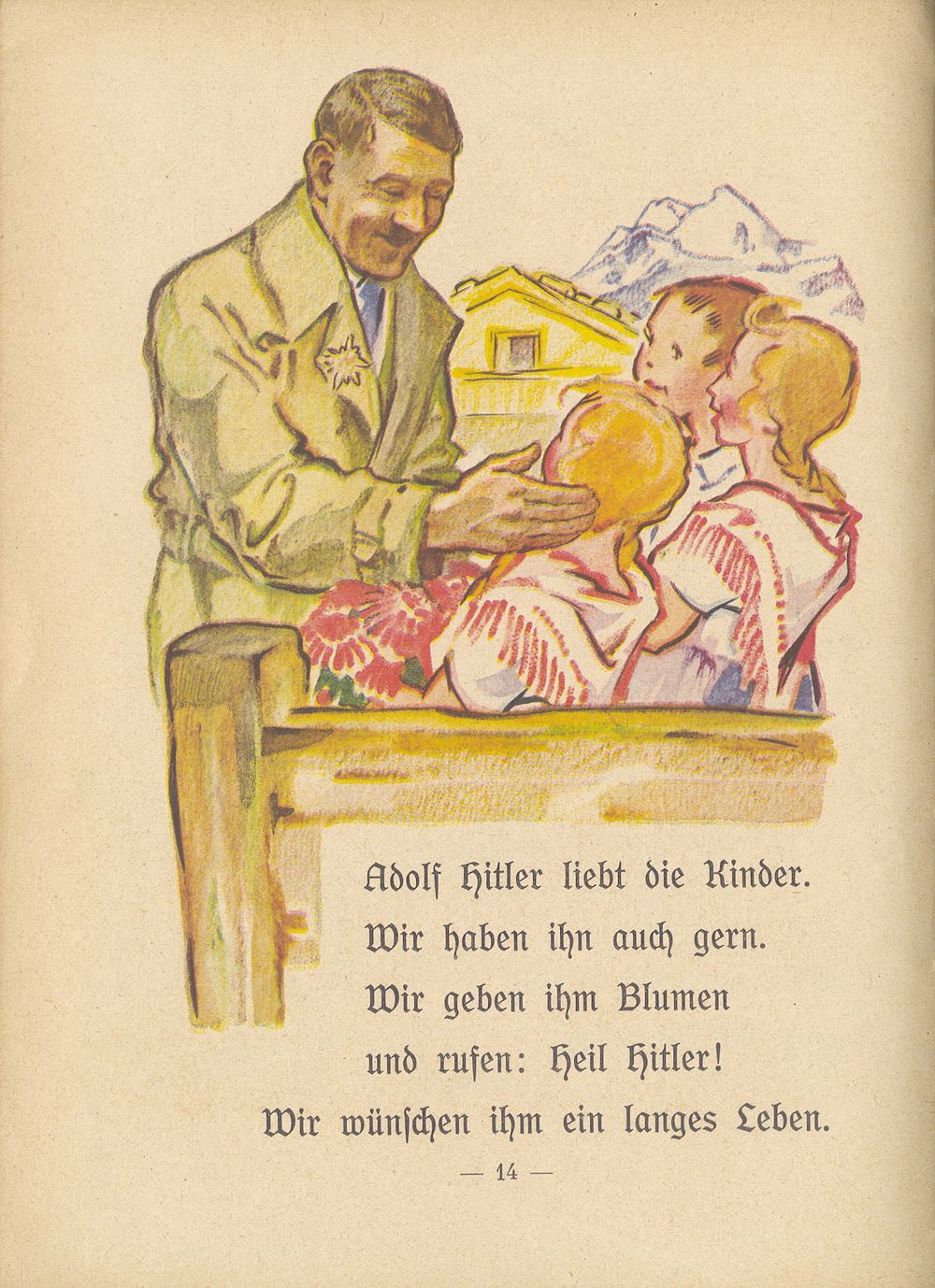
Wir Kinder - A Children's Reading Textbook in Nazi Germany Incorporating Explicit Nazi Messages - Munich, [1939] - Wir Kinder: Erstes Lesebüchlein für die altbayerischen und schwäbischen Volkshauptschulen - ”We Children - First Reading Booklet for the Old Bavarian and Swabian Elementary Schools, ” a first primer for learning to read (Fibel), intended for elementary schools in the Bavarian and Swabian regions of Germany - a book for teaching first-grade children to read, incorporating throughout its texts and numerous illustrations messages glorifying the Führer and the Nazi movement. Published by Max Kellerer, Munich, [1939]. Rare. Illustrated stories for children edited by Christian Keller, Barthel Reinlein, and Hans Stanglmaier, accompanied by illustrations by Margret Wolfsinger. The book combines short children's songs, folk tales, and colorful illustrations of a rural and traditional character with Nazi songs and stories praising Hitler and Nazi Germany. Alongside innocent children's songs and stories such as Little Red Riding Hood, Mother Does the Laundry, Wind, Wind Is Blowing, The Birds Set Out on a Long Journey, and the like, there are songs containing explicit Nazi messages. Thus, for example, a song praising Adolf Hitler appears, accompanied by an illustration of Adolf Hitler caressing young girls: ”Adolf Hitler loves children. We love him too. We give him flowers and shout: Heil Hitler! We wish him a long life.” The passage ”Bring Out the Flags” is accompanied by an illustration of crowds of Germans in the streets waving swastika flags: ”Today is a day of celebration. In every village and town, our proud flags are flying. Everywhere, the German colors of black, white, and red greet us, and in every street, Hitler's red flags with the swastika shine brightly. White and blue like the sky are the Bavarian flags. Everyone is happy. Many people shout in the street: Heil Hitler! Fireworks explode, music plays, and everyone sings the German national anthem.” Beside it appears the song ”Out into the Distance, ” describing the Hitler Youth setting out on an excursion through the fields with swastika flags. Likewise, in the reading passages at the end of the book, in which the child learns German cursive script, appear the lines: ”Heil Hitler! Germany Above All, ” and the like. More in the book appears a song entitled ”These Are Our Soldiers, ” glorifying the German army and accompanied by an illustration of German Wehrmacht soldiers: ”These are our soldiers. Look how they march in perfect step! Do you also want to be soldiers?...” Also included is a song entitled ”The Soldiers' Memorial”: ”A great many boys and men went off to the Great War. They were brave soldiers. So many did not come home. The soldiers' memorial says: Remember the fallen heroes!” In a song praising Hindenburg under the title ”Our Hindenburg, ” the following passage appears: ”Be grateful, German child! Germany, Germany above all, above all in the world, when it always stands together in brotherhood for protection and security! That is what we sing at school. Germany is our beautiful homeland. We will always love it. We will all help her when she is in danger. That is what our Hindenburg and our Hitler want.” It was a chilling phenomenon that reveals the depth of totalitarian control through the poisoning of young minds and the systematic engineering of children's consciousness by means of school textbooks in Nazi Germany. Instead of innocent fairy tales, the Nazi educational and propaganda system instilled messages of personality cult, ideological blindness, and absolute adoration of Adolf Hitler - exploiting the innocence of young children and turning them into instruments in the service of a murderous ideology even before they had learned to read and write. In numerous children's books intended for first-grade pupils and young children in Nazi Germany, systematic, calculated, and undisguised indoctrination was employed, designed to shape political consciousness from the very first stages of learning to read, before critical thinking had even developed. The texts, illustrations, and pedagogical exercises linked the learning of letters and reading with messages of obedience, sacrifice, and absolute adoration of Adolf Hitler and the Nazi movement, presenting the Führer as a benevolent, protective, and unquestionable father figure. The children depicted in these books were portrayed as future soldiers, as part of a unified national body, while the world was divided in a clear and dichotomous manner between a pure, strong, and righteous ”us” and a parasitic and threatening ”enemy.” Through short songs, simple rhymes, everyday stories, and colorful illustrations, ideas of blind loyalty, racial superiority, and total discipline were instilled as natural and self-evident values. Nazi early-childhood education was intended not merely to teach children to read and write,